Build your marketing, product, design and development agent team
Coordinate specialists around one brief, with explicit handoffs and verification.
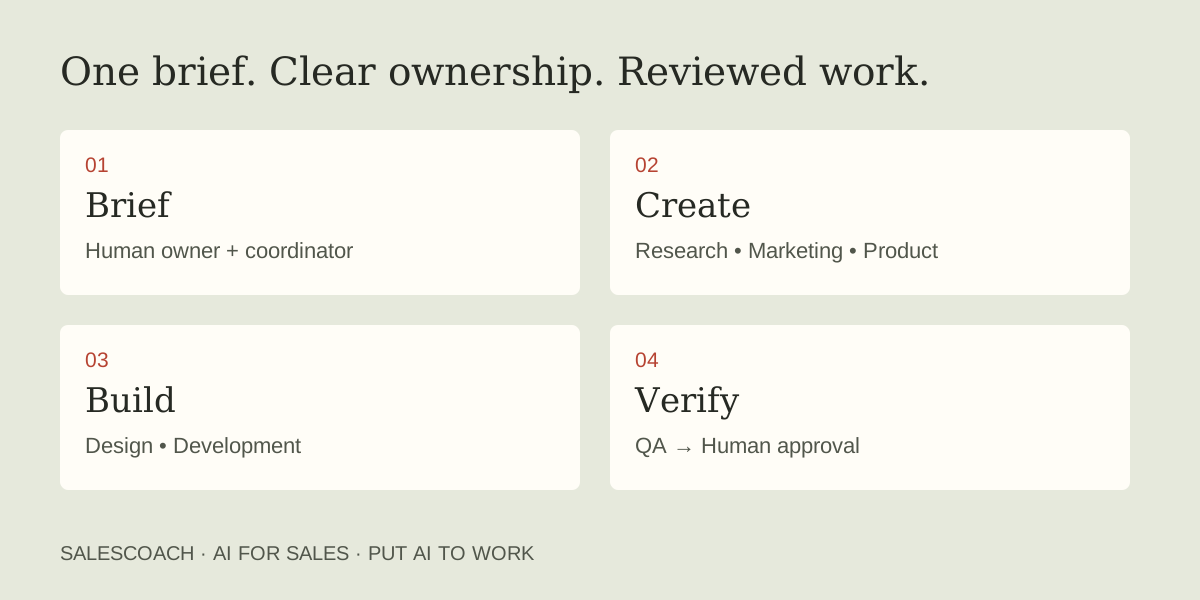
Work through the steps
- Give the coordinator one bounded goal, source pack, deadline, budget, and acceptance checklist. Begin with a researcher, creator, and reviewer; add roles only when a distinct responsibility warrants it.
- Define specialist outputs. Marketing owns message and channel hypotheses. Product owns the problem brief and priorities. Design owns the journey and prototype. Development owns implementation and technical checks. Sales owns buyer evidence and promises.
- Use one shared task record: input sources, owner, dependencies, output location, open questions, reviewer, and status. Require each handoff to explain what changed and what remains unverified. A role prompt alone does not create a running agent.
- Use a separate reviewer to compare outputs with source evidence and acceptance criteria. The human owner approves customer messages, pricing, CRM writes, spend, and publication. Start with a small reversible pilot and inspect logs before expanding permissions.
In practice
Research delivers dated buyer evidence → product identifies the problem → marketing drafts the offer → design prototypes → development implements → QA verifies → the human owner reviews and publishes. Return defects to the responsible role.
A prompt to make your own
Replace the brackets with approved context. Ask the assistant to identify missing information before proceeding, and review its output against your sources.
Act as coordinator for [goal]. Create role briefs for research, marketing, product, design, development, and QA. For each define inputs, deliverable, dependencies, acceptance criteria, permitted actions, and escalation conditions. Plan a small pilot with human review before external actions. Do not claim work is complete without linked evidence.
Your assignment
Run a pilot producing one researched offer brief, one landing-page concept, and one reviewed implementation task.
What to measure
Accepted deliverables, rework, elapsed time, and cost per completed workflow.